Stop Stalling: How to Pick the Best 2025 Beginner Enduro Bike
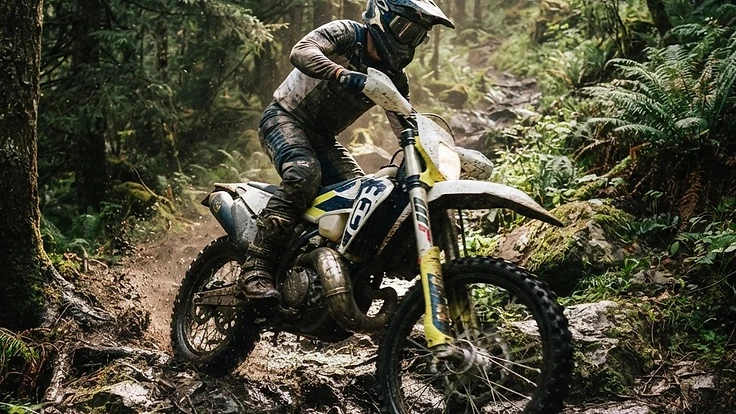
Choosing the wrong machine stalls your progress, so we compared the most forgiving 2-stroke and 4-stroke models to help you master the trails in 2025.
Stepping into technical trail riding requires the right equipment, and finding the best enduro bike for beginners is the most critical decision a new rider will make. The learning curve in technical off-road riding is steep. Selecting a motorcycle with too much power, excess weight, or aggressive suspension geometry will stall your progress and quickly drain your energy. A proper entry-level machine accelerates skill development by providing predictable power delivery, manageable weight, and a chassis designed to forgive common novice mistakes.
In this guide, we dissect the core principles of what makes a motorcycle suitable for a new woods rider. We evaluate the differences between small-displacement two-strokes and mid-weight four-strokes, analyze the exact specifications of current models from KTM, Husqvarna, and GASGAS, and highlight which motorcycles you should avoid as you begin your off-road journey.
Core Principles for New Enduro Riders
When evaluating a beginner motorcycle, novices frequently focus on peak horsepower. This is a crucial error. In technical woods riding, peak horsepower is rarely utilized. Instead, beginners should focus on three fundamental characteristics: weight, power linearity, and clutch pull.
First, weight directly dictates fatigue. When you learn to ride enduro, you will drop the motorcycle repeatedly. Picking up a heavy machine exhausts your muscles and destroys your focus. Lighter motorcycles also react more predictably when deflecting off rocks and roots.
Second, power linearity refers to how predictably the engine builds RPMs when you twist the throttle. A steep, aggressive power curve causes "whiskey throttle," leading to rapid loss of control. Beginners need a flat, smooth torque delivery that pulls steadily from idle without suddenly surging.
Finally, clutch feel is paramount. Technical riding requires constant slipping of the clutch to modulate traction over slick obstacles. A light, hydraulic clutch reduces arm pump and allows for precise micro-adjustments.
Two-Stroke vs. Four-Stroke for Novices
Modern enduro bikes are broadly divided into two engine types. Each offers distinct advantages for the entry-level rider.
Two-strokes are mechanically simpler and noticeably lighter. They stall less easily at very low RPMs, which benefits riders who are just learning clutch control. Because they lack heavy internal valvetrain components, they feel nimble and easy to throw around between tight trees.
Four-strokes provide a broader, smoother power delivery that many beginners find less intimidating. The engine braking inherent to four-stroke designs is highly advantageous on steep descents, as it naturally slows the bike without requiring heavy reliance on the brakes. The downside is increased overall weight and a higher tendency to stall if the rider abruptly releases the clutch at low speeds.
Top Lightweight Two-Stroke Picks
For riders prioritizing agility and minimal fatigue, small-bore two-strokes are unparalleled.
Husqvarna TE 150 (2025)
The Husqvarna TE 150 is a premier entry point into technical riding. Tipping the scales at a mere 100.2 kg (without fuel), it is light, allowing novices to muscle the bike through deep ruts and over logs with minimal physical strain.
Powered by a 144 cc engine, the TE 150 forces the rider to learn proper momentum conservation and gear selection rather than relying on raw engine torque. At $10249, it is an accessible option that rewards proper technique. The smooth, hydraulic clutch and compliant suspension make it highly forgiving. For a deeper dive into riding techniques on this chassis, review our guide on Momentum Over Muscle: Mastering Hard Enduro on the 2025 GASGAS EC 250 and Husqvarna TE 150.
GASGAS EC 250 (2025) (previously listed here as GasGas EC 200)
For beginners who have a minor background in off-road riding or those who are physically heavier, the GASGAS EC 250 offers a step up in capability. It weighs 107.6 kg (without fuel) and features a displacement of 249 cc.
The hydraulic clutch and softer suspension valving typical of GASGAS models keep the ride plush and compliant. At $10499, the EC 250 delivers a brilliant chassis that a novice can grow into over several seasons without feeling the need to upgrade immediately.
Top Mid-Weight Four-Stroke Picks
If you prefer linear torque and the safety net of engine braking on descents, the 350cc four-stroke category provides excellent options. These models bridge the gap between lightweight 250s and heavy 450s, offering tractable power without the massive rotational mass of open-class bikes.
KTM 350 EXC-F (2025)
The KTM 350 EXC-F is widely regarded as one of the most versatile off-road motorcycles available. Displacing 349.7 cc, the engine is tuned to focus heavily on low-end traction rather than a high-RPM surge.
Weighing 107 kg (without fuel, international spec), the weight is centralized well. The KTM utilizes a PDS (Progressive Damping System) rear shock, meaning there is no low-hanging suspension linkage beneath the swingarm. This design prevents novices from getting hung up on logs and large rocks. Priced at $12649, it is a premium investment, but one that delivers smooth power delivery.
Husqvarna FE 350 (2025)
Sharing the same 349.7 cc engine platform as its KTM cousin, the Husqvarna FE 350 differs primarily in the chassis components and suspension design.
Husqvarna employs a traditional linkage rear suspension. While you sacrifice a small amount of ground clearance compared to the KTM, the linkage provides a planted, comfortable ride over continuous rough terrain and braking bumps. It is not in the 2025 US lineup; the US gets the street-legal FE 350s ($12,749). To understand the subtle handling differences, check out our KTM 350 vs Husqvarna FE 350: Choosing the Right Austrian Mid-Weight comparison.
Specification Comparison Table
Review the hard data below to see how these beginner-friendly models stack up against one another.
| Spec | Husqvarna TE 150 (2025) | GASGAS EC 250 (2025) | KTM 350 EXC-F (2025) | Husqvarna FE 350 (2025) | | :--- | :--- | :--- | :--- | :--- | | Engine | 2-Stroke | 2-Stroke | 4-Stroke | 4-Stroke | | Displacement | 144 cc | 249 cc | 349.7 cc | 349.7 cc | | Weight | 100.2 kg (without fuel) | 107.6 kg (without fuel) | 107 kg (without fuel, intl spec) | Not verified | | Price | $10249 | $10499 | $12649 | Not in 2025 US lineup; US gets street-legal FE 350s ($12,749) |
Motorcycles Beginners Must Avoid
A frequent mistake made by new riders is purchasing an open-class (450cc or larger) motorcycle based on the assumption they will "grow into it." In technical woods riding, this approach backfires severely.
Bikes like the KTM 450 EXC-F (449.9 cc, 107.4 kg without fuel) and the Honda CRF450RX (449.8 cc, 116.1 kg curb full tank) are built for open-desert high speeds or professional-level racing. Because their weights use different measures, they are not directly comparable, but both demand extreme physical strength to control in tight sections. The internal rotating mass of a 450cc piston generates a gyroscopic effect, making the motorcycle feel significantly heavier when transitioning from side to side.
Attempting to learn clutch control and pivot turns on these machines usually results in rapid fatigue, broken levers, and a severe loss of confidence. Stick to the lightweight models detailed above to ensure your early trail sessions are productive and safe.
Budgeting for Your First Enduro Bike
Purchasing the motorcycle is only the first financial step. Proper preparation requires budgeting for protective equipment and essential machine protection.
Beginners drop their bikes often. You must install a heavy-duty skid plate, wrap-around aluminum handguards, and radiator guards before hitting the trail. These components prevent a simple tip-over from destroying an expensive radiator or engine case.
Furthermore, high-quality off-road gear is non-negotiable. Enduro boots with rigid ankle support (approx. $300 to $600) are critical to prevent fractures when catching a foot on a stump. Add a dedicated off-road helmet, knee braces, and a chest protector to your initial budget calculation. For a comprehensive look at ownership costs, read our 2025 Enduro Price Guide: Why the MSRP Is Only the Beginning.
Properly outfitting yourself and your machine ensures that when the inevitable crash happens, you can simply pick the bike up, dust yourself off, and continue refining your skills on the trail.
Frequently Asked Questions
Is a 300cc two-stroke a good choice for a beginner?
Generally, no. While 300cc two-strokes are popular in hard enduro, they produce substantial low-end torque that can easily pull a new rider out of position. The lighter pull of a 144 cc or 249 cc machine is much safer for mastering fundamental techniques.
Do I need to buy a brand new motorcycle to learn?
Not at all. While the 2025 models offer the latest suspension and fuel injection technology, many riders start on reliable used models from the past decade. If purchasing used, ensure the bike has been maintained well, particularly checking the suspension linkage, wheel bearings, and piston hours.
What is the lightest beginner enduro bike available right now?
Based on our catalog, the Husqvarna TE 150 (2025) weighs just 100.2 kg (without fuel). This low weight is a massive advantage for physical endurance.
Why shouldn't I just buy a motocross bike for the trails?
Motocross motorcycles are designed for closed-course tracks with massive jumps. They feature incredibly stiff suspension, a tall first gear, and abrupt power bands. In technical woods, an MX bike will deflect aggressively off rocks, overheat quickly at low speeds, and constantly stall due to the lack of flywheel weight.
How important is suspension setup for a beginner?
It is absolutely vital. Regardless of which motorcycle you choose, you must set the "sag" (spring preload) for your specific body weight before your first ride. An unbalanced motorcycle will not steer properly, making it exponentially harder to navigate technical terrain.
Keep Reading


Join the Enduro University community
Create a free account to comment on this article, make race predictions, play daily trivia, build your virtual garage, enter the photo contest and climb the leaderboards.
Related Stories



Comments (0)
Be the first to comment.