Mastering the Descent: How to Ride Downhill Enduro Safely
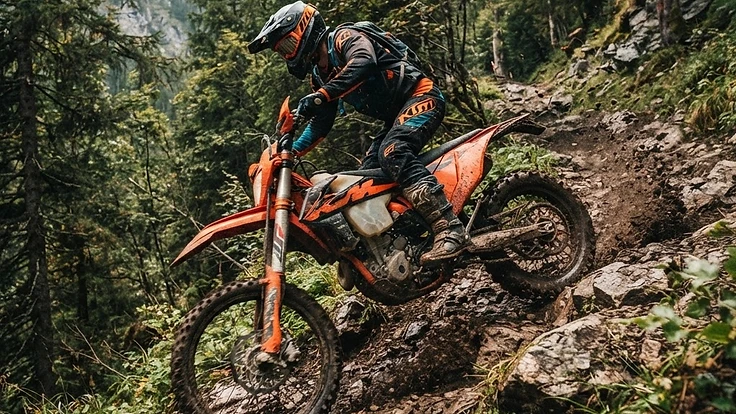
Learning how to ride downhill enduro safely requires proper braking, body positioning, and line choice. Master steep off-road descents with these expert tips.
By Enduro University Desk
Learning exactly how to ride downhill enduro safely is an essential skill for any off-road motorcyclist. While steep, technical climbs often receive the most attention from riders and spectators alike, getting back down the mountain safely demands entirely different mechanics. When gravity takes over, improper technique can quickly result in locking the wheels, losing traction, or pitching over the handlebars. Surviving and conquering steep descents involves specific body positioning, highly controlled braking modulation, correct visual habits, and an understanding of how your motorcycle's engine and suspension react to weight transfer.
Downhill riding is intimidating because the visual perspective makes obstacles look larger and more threatening. The instinct for many riders is to stiffen their arms, lean far back, and aggressively grab the brakes. Unfortunately, this defensive posture isolates your body from the motorcycle and reduces your ability to steer or adapt to sudden changes in terrain. This guide will walk you through the precise mechanics of safely descending steep enduro trails, ensuring you maintain traction and control no matter how severe the gradient becomes.
Body Positioning for Steep Descents
Proper body position is the foundation of downhill control. When descending, gravity shifts the combined weight of you and the motorcycle onto the front tire. Your goal is to manage this weight transfer so the rear tire stays planted while the front tire remains free to steer and track over obstacles.
Stand on the footpegs. Sitting down during a steep descent places your weight too far forward and locks your hips, making it impossible to adapt to hits from rocks or roots. Hinge at your hips and push your pelvis backward, keeping your head roughly in line with the handlebars. If the hill is extremely steep, your hips should be positioned squarely over, or slightly behind, the rear fender.
Keep your knees slightly bent and grip the motorcycle firmly with your lower legs. This anchors you to the machine and prevents your upper body from sliding forward under heavy braking. Your arms should be extended but never completely locked at the elbows. Locked elbows transfer every impact directly into your shoulders and neck, causing immediate fatigue and a loss of steering control. To properly set up your motorcycle for this posture, you can review our guide on The Anatomy of Enduro Ergonomics: Tailoring the 2025 Fleet for Technical Dominance.
Mastering Braking Control
A persistent off-road myth suggests riders should avoid the front brake when riding downhill to prevent going over the bars. In reality, the front brake provides approximately 70% to 80% of your stopping power during a descent. If you rely solely on the rear brake, the rear wheel will simply lock up and skid, causing you to gain speed and lose directional stability.
The secret is brake modulation. Apply the front brake smoothly, using one or two fingers on the lever. If you feel the front tire begin to wash out or slide, release the pressure slightly and reapply. Never grab the front brake abruptly.
The rear brake should be dragged continuously to keep the chassis settled and manage your speed. Because your weight is shifted backward, the rear tire maintains enough traction to assist with braking without immediately skidding. If the rear wheel does lock and begins to slide sideways, gradually ease off the rear brake pedal until it falls back in line behind the front wheel.
Engine Braking: Two-Stroke vs. Four-Stroke
Your motorcycle's engine configuration drastically alters how you approach a downhill section. Four-stroke motorcycles naturally provide engine braking when the throttle is closed. As the piston works against engine compression, it slows the rear wheel without requiring constant input on the rear brake pedal. This makes rolling down long, steady hills relatively straightforward, provided the terrain offers decent traction.
Two-stroke motorcycles, however, lack significant engine braking. When you roll off the throttle on a two-stroke, the bike essentially free-wheels, forcing the rider to rely almost entirely on the front and rear hydraulic brakes to control speed. For technical hard enduro, many riders prefer lightweight two-strokes for their agility, but they require much more active braking on descents.
Below is a comparison of two popular Austrian enduro machines that highlight the mechanical differences impacting downhill control:
| Spec | KTM 300 EXC (previously listed here as KTM 300 EXC TPI) 2025 | KTM 350 EXC-F 2025 | | :--- | :--- | :--- | | Engine Type | 2-Stroke | 4-Stroke | | Displacement | 293.2 cc | 349.7 cc | | Weight | 104.6 kg (without fuel) | 107 kg (without fuel, international spec) | | Price | Sold in the US as the 300 XC-W ($11,599) | US list $12649 |
Regardless of your engine type, clutch control is vital. On a four-stroke, if your rear wheel locks up from braking, the engine will stall. You must be prepared to pull the clutch in instantly to keep the engine running, then smoothly release it to re-engage engine braking. On a two-stroke, you will frequently pull the clutch in entirely on steep, technical descents to prevent the engine from pushing you forward when navigating tight switchbacks.
Vision and Line Selection
Where you look dictates where the motorcycle goes. Target fixation is highly dangerous on a descent. If you stare at a large rock or a deep rut directly in front of your front tire, you will inevitably hit it. Instead, scan the trail 15 to 20 feet ahead.
Look for traction. Solid rock slabs, dry dirt, and exposed roots running perpendicular to the trail generally offer grip. Avoid wet clay, loose scree, and roots running parallel to your tires, as these will deflect the front wheel and cause a sudden loss of steering.
If the trail is deeply rutted, commit to the rut early. Enter the rut slowly and allow the walls of the trench to guide the tires. Trying to cross-rut or climb out of a deep trench on a steep downhill usually results in a crash. Keep your eyes up, spot your exit, and let the motorcycle do the work.
Managing Switchbacks and Steep Drops
Many downhill trails do not run straight down the fall line. They traverse the hillside with tight switchbacks. When approaching a downhill switchback, do all of your heavy braking while the motorcycle is traveling in a straight line. As you enter the turn, release the front brake pressure and lean the motorcycle slightly beneath you, keeping your body weight centered over the outside footpeg to maintain tire bite on the cambered surface.
For extreme hard enduro descents where the trail is too tight to steer through normally, you may need to utilize advanced techniques. Learning to pivot the bike around its headstock or rear wheel can save you from tumbling down a cliff. Read our guide on Mastering the Technical Pivot Turn: The Ultimate Hard Enduro Lifeline to understand how to maneuver in zero-space situations. A lightweight chassis, such as the 100.2 kg (without fuel) Husqvarna TE 150 2025, makes these tight directional changes significantly less exhausting.
Bike Setup for Downhill Control
Your motorcycle setup dictates how forgiving it will be on a descent. Suspension valving and clicker settings are crucial. Because weight transfers heavily to the front, your forks will sit lower in their stroke. If your fork compression damping is too soft, the front end will dive excessively under braking, creating a steep head angle that makes the bike twitchy and prone to tucking the front wheel. Stiffening the fork compression slightly can keep the front end higher and maintain stability.
Tire pressure also plays a massive role. Running standard inner tubes at 12-15 PSI is fine for dual-sport riding, but for technical enduro descents, riders typically run mousse inserts or Tubliss systems mimicking 4-8 PSI. This allows the tire carcass to flatten against rocks and roots, drastically increasing your braking surface area.
Lastly, adjust your control levers. Your clutch and front brake levers should be rotated slightly downward. When you are standing and leaning backward on a steep descent, this downward angle ensures the levers align perfectly with your forearms, reducing wrist strain and allowing you to operate the brakes smoothly without awkwardly rolling your hands forward over the grips. Ensure you always wear proper protective equipment; high-quality knee braces and rigid enduro boots (ranging from approx. $200–$600) are vital for protecting your joints if you need to dab a foot on an uneven downhill surface.
If you want to understand how climbing relates to descending, understanding uphill mechanics can help balance your skill set. Check out our complementary guide on Master the Physics of Near-Vertical Hard Enduro Hill Climbs.
Frequently Asked Questions
How do I stop sliding on loose rocks downhill?
To stop sliding, avoid aggressively locking either wheel. Locking a tire breaks traction completely. Instead, drag both brakes lightly, keeping the wheels slowly rolling. A rolling tire maintains directional control and actually provides more stopping friction on loose terrain than a skidding tire. Shift your weight further back to increase pressure on the rear tire.
Should I sit or stand when riding down steep hills?
You should stand for almost all descents. Standing lowers your center of gravity to the footpegs, allows you to shift your body weight backward over the rear fender, and lets your legs absorb sudden impacts. Sitting down traps your weight near the front of the bike and limits your ability to react to the terrain.
Do I use the clutch when going downhill?
Yes, especially on a four-stroke motorcycle. If you brake hard enough to lock the rear wheel, the engine will stall if the clutch is engaged. You must pull the clutch in to prevent stalling, then smoothly release it to re-engage engine braking once the wheel is rolling again. On a two-stroke, you will use the clutch constantly to modulate power and coast through tight switchbacks.
What happens if I stall on a steep descent?
If you stall on a descent, immediately pull the clutch in and keep both brakes applied so you do not lose control of your speed. If you are on a four-stroke, you can slowly release the clutch to bump-start the engine using the downhill momentum, provided you have sufficient traction. Otherwise, use the electric start while continuing to manage your braking.
Which brake is more important on a downhill?
The front brake is the most important, providing the majority of your stopping power. Because gravity forces the vehicle's weight onto the front tire, it has the most traction. However, it requires precise, gentle modulation to prevent the wheel from washing out. The rear brake is used to steady the chassis and manage speed, but it cannot stop the bike quickly on a steep hill by itself.
Keep Reading


Join the Enduro University community
Create a free account to comment on this article, make race predictions, play daily trivia, build your virtual garage, enter the photo contest and climb the leaderboards.
Related Stories



Comments (0)
Be the first to comment.