Tyre and Mousse Choice for Every Condition
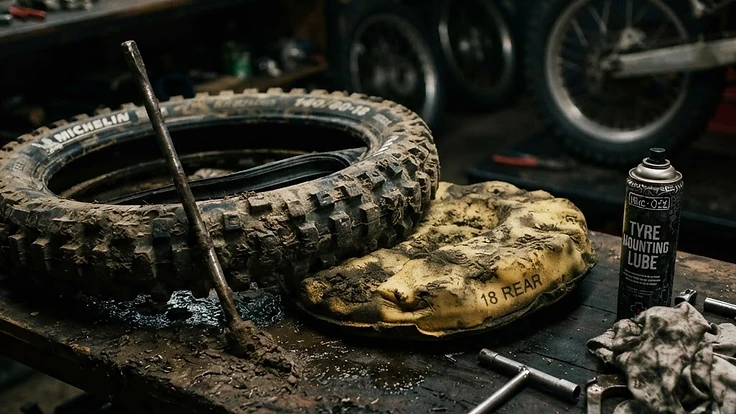
A practical, evergreen guide to choosing enduro tyres and mousses by terrain, speed, bike feel, and durability. It explains how to match front and rear tyres, pick mousse firmness, avoid common setup mistakes, and know when your setup is truly working.
Tyre and Mousse Choice for Every Condition
Your tyre and mousse choice can make a bike feel planted and easy, or nervous and exhausting. In hard enduro and technical trail riding, the wrong setup costs more energy than most riders realize. If you choose tyres and mousses by terrain, speed, and feel instead of guesswork, the bike starts helping you instead of fighting you.
Start With the Three Questions That Matter
Before you pick anything, answer these three questions:
- What ground will you ride most today? Rock, roots, mud, loam, sand, hardpack, or a mix.
- How fast will you ride? Slow technical pace, normal trail pace, or fast special-test pace.
- What matters most today? Maximum grip, steering accuracy, puncture resistance, or tyre life.
Most riders get in trouble because they answer only the first question. Terrain matters, but speed and priority matter just as much. A tyre that works brilliantly in wet rocks at walking pace can feel vague and unstable when you start pushing harder on dry hardpack.
Understand the Two Big Choices: Tyre and Mousse
Think of the system in two parts.
- The tyre gives the tread pattern, rubber compound, sidewall stiffness, and carcass shape.
- The mousse controls how supported the tyre feels, how much it deforms, and how well it survives heat and impacts.
A soft gummy tyre with a firm mousse often works worse than riders expect: the rubber wants to wrap around terrain, but the mousse stops it. A stiffer enduro tyre with a very soft mousse can feel dead, vague, and easy to burp off line in heavy hits. You need the two parts to match.
Choose the Rear Tyre First
The rear tyre does most of the work in technical enduro. Pick that first.
For wet rock, roots, slick climbs, and hard enduro
Choose:
- Soft or super-soft compound
- Flexible carcass
- Trials-style behavior without going full trials unless terrain is very specific
What you want is a rear tyre that deforms and drives forward at low speed. A gummy-style enduro rear with open tread and a compliant carcass is usually the best answer. It lets the tread wrap around edges instead of spinning on top of them.
Use this when:
- Traction matters more than tyre life
- Speeds are low to moderate
- You are riding technical climbs, creek beds, roots, rock ledges, and slippery off-camber sections
For mixed trail, dry dirt, and general enduro
Choose:
- Medium-soft compound
- More supportive carcass
- Balanced tread spacing
This is the safest all-round rear. It still grips well in technical sections, but it handles better at speed, resists tearing, and lasts longer. If you only want one rear setup for most of the year, this category makes the most sense.
For sand, deep loam, and softer ground
Choose:
- A paddle-like, open tread pattern
- Enough knob height and spacing to clear itself
- A carcass that does not collapse too easily
In sand and loam, you need drive and self-cleaning. Too-soft carcasses can make the rear feel vague and wallowy. You still want compliance, but you need support to keep the bike driving straight.
For hardpack, high speed, and rocky punishment
Choose:
- Medium compound
- Stronger carcass
- A tyre that resists chunking and squirm
If the pace is high and impacts are big, durability and stability matter more than ultimate crawl-speed grip. A super-soft gummy rear may overheat, tear knobs, and feel unstable.
Then Match the Front to Steering Feel
Most riders obsess over the rear and ignore the front. That is a mistake. Your front tyre decides whether you trust the bike enough to commit.
For slippery roots, rock, and off-camber terrain
Choose:
- Soft to medium-soft front compound
- Predictable side knobs
- A carcass that conforms without folding
You want the front to bite early and tell you what it is doing. A front that suddenly tucks is worse than one with slightly less outright grip.
For faster riding and hardpack
Choose:
- More supportive front carcass
- Clear shoulder support
- A compound that does not overheat or smear
Too soft a front at speed can feel vague on braking and corner entry. If you race cross-country or ride faster transfer-style terrain, support matters.
Pick Mousse Firmness by Speed and Feel
Forget the idea that there is one perfect mousse. There is only the right firmness for your speed, terrain, and tyre.
Soft mousse
Best for:
- Hard enduro
- Wet rock and roots
- Low-speed technical riding
- Riders who want maximum footprint and compliance
Trade-offs:
- More heat buildup if ridden fast
- Less support in hard impacts
- Can feel vague on fast turns or heavy braking
Medium mousse
Best for:
- Mixed enduro
- Riders who do technical sections but also cover ground at pace
- One-setup riders
Trade-offs:
- Less ultimate crawl-speed grip than a very soft mousse
- More stable and durable overall
Firm mousse
Best for:
- Faster riding
- Rally-style terrain, hardpack, and hard hits
- Riders who hate a vague tyre feel
Trade-offs:
- Less conformity over roots and rock
- More deflection in technical terrain
- Can make a soft tyre feel harsh and skittish
As a general rule: slower and slicker means softer; faster and hotter means firmer.
Build a Practical Setup by Condition
Use this simple method.
1. Wet technical hard enduro
- Rear: soft gummy, flexible carcass
- Front: soft/medium-soft technical enduro front
- Mousse: soft rear, soft-to-medium front
Goal: grip and conformity.
2. Mixed woods and club enduro
- Rear: medium-soft enduro tyre
- Front: reliable all-round front with good braking bite
- Mousse: medium rear, medium front
Goal: balance.
3. Dry hardpack and faster terrain
- Rear: stronger medium-compound tyre
- Front: supportive front with stable side knobs
- Mousse: medium-firm rear, medium front
Goal: accuracy and durability.
4. Sand or loam
- Rear: open-pattern sand-friendly tyre
- Front: front that floats without knifeing
- Mousse: medium rear, medium front
Goal: drive and straight-line support.
Check Wear and Heat, Not Just Grip
A setup can feel good for 20 minutes and still be wrong.
After the ride, inspect:
- Knob tearing: usually too much wheelspin, too soft a compound for the terrain, or too much heat
- Blueing or overheating feel: mousse too soft for the pace
- Front edge tearing: front pushed too hard, wrong compound, or carcass too soft for braking load
- Dead, harsh feel: mousse too firm or dried out
- Wallowing or vague line holding: carcass too soft, mousse too soft, or tyre too worn
If you ride liaison sections, road, or sustained fast ground, heat becomes a major factor. Soft mousses break down faster when run hot for long periods.
Fine-Tune for Your Weight and Riding Style
Your setup is not only about terrain.
- If you are heavier, aggressive, or hit things hard, you usually need more support.
- If you are lighter, smoother, or ride very technical terrain, you can benefit from softer mousses and more compliant tyres.
- If you steer a lot with the rear, you may prefer a slightly more supportive rear.
- If you hate front-end washouts, put more thought into the front tyre than most riders do.
Do not copy a top rider's setup blindly. Their speed, strength, and terrain may be completely different from yours.
Common Mistakes
- Choosing the softest gummy rear for every ride, then wondering why it tears apart or feels vague at speed
- Running a firm mousse inside a soft technical tyre and killing the very grip you bought the tyre for
- Ignoring the front tyre and focusing only on rear traction
- Using a soft mousse for long, fast, hot rides and cooking it
- Judging a setup only in the first slick climb instead of across the whole ride
- Keeping a worn mousse too long because it still "kind of works"
- Mounting a tyre and mousse combination that is physically mismatched in size, creating a weird profile
- Confusing comfort with grip; a soft feel is not always better drive or better steering
- Using a hard-terrain front in wet roots and then blaming technique for every push and tuck
- Never checking how the tyre wears, tears, or changes after a few rides
Maintain the System Properly
A good setup needs basic care.
- Use proper mousse lubricant during installation
- Re-check the tyre after the first ride for seating and feel
- Store the bike out of heat when possible
- Replace mousses before they become dry, shrunken, or inconsistent
- Rotate tyres out before they are so rounded or torn that testing becomes meaningless
If a setup suddenly feels worse, do not assume the terrain changed. Often the mousse has aged or the tyre profile has gone off.
What Good Looks Like
The bike tracks where you point it without making you fight for every line. The rear grips on ugly climbs without constant wheelspin, and the front gives you enough warning that you can trust it on roots, rock, and braking edges. You feel support when you hit things, but the tyres still wrap and find traction instead of deflecting.
At the end of the ride, you are less tired, less tense in your hands, and less likely to say the bike felt nervous or unpredictable. That is the real test: not just one hero section, but a setup that lets you ride cleanly, repeatably, and with confidence across the whole day.
Keep Reading


Join the Enduro University community
Create a free account to comment on this article, make race predictions, play daily trivia, build your virtual garage, enter the photo contest and climb the leaderboards.
Related Stories



Comments (0)
Be the first to comment.