Two-Stroke vs Four-Stroke: An Honest Comparison
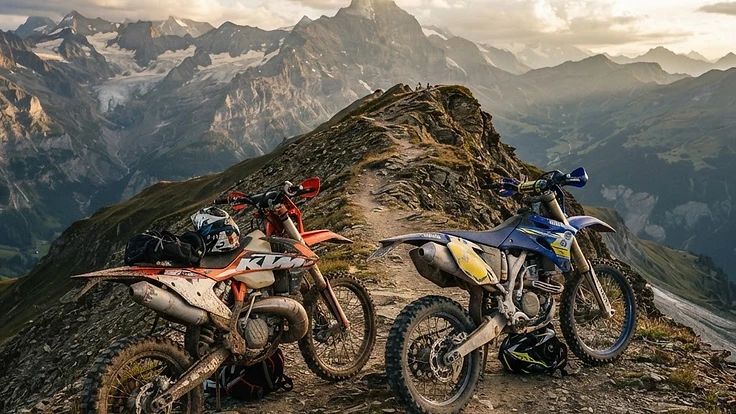
A practical, rider-focused guide to choosing between a two-stroke and four-stroke for enduro and hard enduro, covering power, handling, traction, maintenance, cost, and how to test and decide based on your terrain and riding style.
If you ride enduro, this choice affects more than engine sound. It changes how tired you get, how often you use the clutch, how the bike finds traction, and how expensive your mistakes become. You do not need a tribal answer; you need a bike that fits your terrain, pace, and skill.
Start With How You Actually Ride
Before you compare engines, define your real use. Do this in order:
- List your terrain. Tight trees, slick rocks, long hill climbs, open sand, desert, mud, or mixed loops.
- Be honest about speed. Are you a club-level rider cruising trail pace, racing sprints, or riding proper hard enduro where balance and recovery matter more than top speed?
- Count your ride length. One-hour motos and special tests reward different traits than four-hour trail rides.
- Note your fitness and clutch skill. A bike that feels exciting for 20 minutes can feel like work after two hours.
This matters because the best engine is the one that lets you ride cleaner for longer. Not the one that feels fastest in the first straight.
Understand the Real Difference in Power Delivery
A two-stroke and a four-stroke can make similar lap times, but they do it differently.
Two-stroke:
- Feels lighter in the way it picks up revs.
- Builds power faster and responds sharply to throttle input.
- Usually wants more clutch work in technical riding, especially if you let the revs drop too far.
- Can be easier to correct with a quick blip over logs, ledges, and holes.
Four-stroke:
- Makes smoother, longer torque.
- Hooks up well when the ground is loose or slick.
- Lets you be a gear high and a little lazy with technique.
- Gives stronger engine braking, which helps some riders and annoys others.
The practical takeaway is simple: if you like to be active with the bike and use throttle and clutch to place the front wheel exactly where you want, a two-stroke often feels more precise. If you want the rear tire to drive forward with less drama and less clutch input, a four-stroke often feels calmer.
Compare Them in Technical Enduro
In proper technical terrain, the differences get clearer.
If you ride tight, slow, nasty ground
A two-stroke usually gives you:
- Less overall weight and less rotating mass feel.
- Easier recovery when you stall, dab, or get off line.
- Less fatigue when you have to drag, pivot, or manhandle the bike.
- Fast front-wheel lift with a small input.
A four-stroke usually gives you:
- Better drive when traction is available.
- More stable chugging on climbs if you are smooth.
- More punishment if you stall in a bad place or need to pick the bike up repeatedly.
- More engine braking entering awkward turns or drop-ins.
For hard enduro, many riders prefer a two-stroke because mistakes are cheaper in energy. When you are already tired, that matters more than dyno numbers.
Compare Them in Faster, More Open Riding
As speeds rise, four-strokes start making more sense for many riders.
In open ground, a four-stroke often feels:
- More planted.
- Easier to drive out of long turns.
- Less busy at steady throttle.
- Better when you want broad power without a hit.
A two-stroke in the same terrain can feel:
- Lively and fun.
- Fast if you keep it in the right rpm.
- More demanding if traction is inconsistent and your throttle hand is abrupt.
If you race cross-country, desert, or faster enduro tests, a four-stroke can reduce workload. If your riding is mostly first- and second-gear problem-solving, the balance often swings back to two-stroke.
Use This Step-by-Step Test Ride Checklist
Do not buy from specs or internet arguments. Ride both, then check these points in order.
1. Start from dead slow
Ride at walking pace on a slight incline. Ask:
- Can you balance and meter the power cleanly?
- Does the bike want to stall?
- Are you slipping the clutch constantly?
2. Do three tight turns each way
Use flat ground first, then off-camber if possible. Ask:
- Does the bike fall in, stand up, or track naturally?
- Does engine braking help or push you wide?
- Can you get back on throttle without spinning?
3. Climb something ugly
Pick a rooted or rocky hill, not a clean fire road. Ask:
- Can you tractor up without panic revs?
- If you lose momentum, can you recover?
- If you stall, how bad is the restart and reposition?
4. Lift the front wheel on demand
Do a controlled blip over a small obstacle. Ask:
- How much effort does it take?
- Can you repeat it when tired?
5. Ride for at least 45 minutes
Your first 10 minutes are misleading. Later, ask:
- Which bike makes your forearms tighter?
- Which one asks more from your clutch hand?
- Which one lets you make fewer big mistakes?
The right answer is usually the bike that still feels manageable after fatigue starts.
Think About Maintenance Without Myths
This part gets oversimplified. Keep it practical.
Two-stroke maintenance reality:
- Top-end work is usually simpler and cheaper.
- There are fewer moving parts in the engine.
- You still need to jet or map it correctly, keep the air filter clean, and watch piston hours.
- Premix or oil injection is not a hardship, but it is another system to manage.
Four-stroke maintenance reality:
- Routine care matters more because valve train and oil condition matter more.
- Oil changes are more critical.
- Major engine work usually costs more.
- A well-maintained four-stroke can be very reliable, but neglect gets expensive faster.
If you do your own work and want lower rebuild cost, two-stroke ownership is usually friendlier. If you are disciplined with service and value smooth torque, a four-stroke is still a very sensible tool.
Match the Bike to Your Skill and Habits
Choose a two-stroke if most of these are true:
- You ride tight woods, rocks, logs, and steep technical climbs.
- You value lower-feeling weight and easy front-wheel placement.
- You are comfortable using clutch and throttle actively.
- You want simpler engine work and lower rebuild cost.
Choose a four-stroke if most of these are true:
- You ride faster, more open terrain or mixed racing.
- You prefer smooth drive and less hit.
- You like short-shifting and letting torque do the work.
- You are fine with stricter maintenance discipline and higher repair stakes.
If you are a newer rider, do not assume a four-stroke is always easier. In technical riding, a lighter-feeling two-stroke can actually save energy and confidence. If you are aggressive but imprecise, a four-stroke can flatter you right up until it wears you out.
Common Mistakes
- Buying based on peak horsepower instead of your terrain.
- Doing a five-minute parking lot ride and calling it a test.
- Ignoring fatigue. The wrong bike often feels fine until the second hour.
- Confusing traction with speed. A bike that hooks up nicely is not automatically faster for you.
- Picking the bike your fastest friend rides, even though your pace and terrain are different.
- Assuming two-strokes are always wild and four-strokes are always easier. Setup and rider input change a lot.
- Overlooking engine braking. It strongly affects corner entry and steep descents.
- Underestimating restart drama on technical climbs, especially when tired.
- Caring about maintenance theory more than your real service habits.
- Choosing too much engine either way. Excess power usually makes you slower in enduro.
What Good Looks Like
You end up on the bike that lets you ride the line you chose, not the line the engine forced on you. In slow technical ground, you can recover from mistakes without burning all your energy. In faster sections, the bike stays calm enough that you can breathe, look ahead, and keep traction instead of fighting reactions.
The correct choice feels boring in the best way: fewer surprises, fewer panic moments, less arm pump, and better decisions late in the ride. You finish with enough left to attack one more climb, not just survive the ride back to the truck.
Keep Reading


Join the Enduro University community
Create a free account to comment on this article, make race predictions, play daily trivia, build your virtual garage, enter the photo contest and climb the leaderboards.
Related Stories



Comments (0)
Be the first to comment.