Trail Etiquette and Riding Responsibly
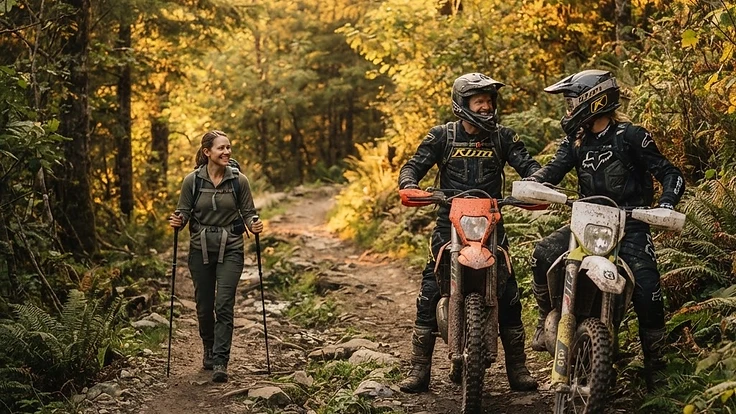
A practical, evergreen guide to riding trails without creating conflict, damage, or bad habits. Learn how to share space, protect access, ride past people safely, and leave the trail in better shape than you found it.
You can be a fast, capable rider and still be the person everyone is happy to meet on the trail. Good trail etiquette is not about being soft or slow; it is about keeping access open, avoiding conflict, and riding in a way that does not wreck the trail or the day for everyone else.
Know Where You’re Allowed to Ride
Start here, every time. A lot of bad trail behavior starts before the bike even leaves the truck.
- Confirm the trail is open to motorcycles. Do not assume because you rode it last year that it is still legal now. Seasonal closures, forestry work, fire risk, wildlife restrictions, and local landowner issues change often.
- Learn the rule set for that area. Some places allow plated bikes only. Some require spark arrestors. Some cap group size. Some are one-way.
- Use the official access point. Do not cut through fields, private driveways, campsite edges, or closed gates because it is quicker.
- Park without blocking anyone. Leave room for horse trailers, emergency access, and other vehicles. If your van setup turns the trailhead into your living room, you are part of the problem.
If you are unsure whether a trail is legal, treat it as closed until you know otherwise.
Start With a Quiet, Legal Bike
Most access problems are not caused by one heroic mistake. They are caused by repeated irritation: noise, speed near people, and riders who look out of control.
- Keep your exhaust under control. Loud bikes travel farther than your actual riding. People will forgive a bike they barely notice. They will remember the one they heard across a valley.
- Run a spark arrestor where required. It is basic responsibility in dry conditions.
- Fix leaks before you ride. Fuel and coolant on the trail or at the truck make you look careless because you are.
- Carry basic repair and cleanup gear. Zip ties, plug tools, a tow strap, water, and a small trash bag solve a lot of situations before they become someone else’s problem.
A clean, reasonably quiet, mechanically sound bike changes how land managers and other trail users see dirt bikes.
Share the Trail Properly
You do not own the trail because you got there first, because you are faster, or because your bike is harder to turn around than a mountain bike.
When you meet other users, follow a simple process:
- Roll off early. Do not wait until the last second. Closing the throttle early shows control and lowers noise.
- Make yourself predictable. Stay to one side, keep your line, and avoid sudden darting.
- Acknowledge the other person. A nod, hand signal, or quick “morning” goes a long way.
- Yield when it makes sense and when rules require it. Horses always deserve extra care. Stop, shut the bike off if needed, and ask the rider what they want you to do. With hikers and cyclists, slow right down and give space.
- Restart smoothly. Do not roost away like you have been released from prison.
If you come up behind a slower trail user, do not pressure them. Back off, let them hear you, and wait for a safe place. If the trail is narrow, be patient. Ten seconds of delay is cheaper than a confrontation that gets bikes banned.
Ride Past People Without Being "That Rider"
Passing etiquette matters even in fully legal riding areas.
- Approach with reduced speed. If your front wheel is skipping around and the engine is on the limiter, you are already wrong.
- Give a clear cue. A short toot or a calm voice is better than rev bombing.
- Pass only when invited or when there is obvious room. Tight singletrack is not the place to force a move.
- Keep the pass clean. No roost, no shoulder brushing, no last-second panic.
- Thank people. Simple and effective.
Inside your own group, the same rules apply. Faster riders should not bully newer riders into mistakes. If someone is nervous, help them pick spots to let riders through.
Protect the Trail Surface
Responsible riding is not just about being polite. It is about leaving the trail usable.
- Stay on the established line. Do not widen corners, braid around puddles, or make bypasses because the main line looks rough.
- Cross wet ground with care. If the trail is saturated and your tires are trenching it badly, ask whether this is really the day to ride that section.
- Use smooth throttle on climbs and exits. Spinning holes into a hill because you hit it in the wrong gear is rider error, not trail fun.
- Do not lock the rear into every corner. Brake earlier, stay balanced, and let the bike turn instead of plowing the surface apart.
- If you move an obstacle, do it thoughtfully. Do not drag logs off into sensitive ground or create new lines around them.
A good test is simple: if every rider rode this section the way you just did, would the trail still be in decent shape next month?
Close Gates, Respect Land, Leave No Trace
Riding responsibly includes everything around the actual riding.
- Leave gates as you found them. Open stays open. Closed stays closed.
- Do not ride through crops, meadows, creek banks, or clear signs of private use. Even if there is an old tire mark there, that does not make it acceptable.
- Pack out your rubbish. Tubes, energy gel wrappers, cable ties, broken levers, all of it.
- Handle breakdowns without making a bigger mess. Catch fluids if you can, move the bike off the main line, and sort recovery calmly.
- Keep the volume down at trailheads and access roads. Many complaints happen before or after the ride, not during it.
Respect for land is what keeps informal tolerance alive in a lot of places.
Ride With Your Group Without Creating Chaos
Group behavior gets noticed fast.
- Keep the group small if the area is busy. Six riders moving neatly create less friction than twelve strung out across half a mile.
- Set regroup points. Do not stop blind around corners or on top of climbs.
- Wait off the trail where possible. Leave room for others to pass.
- Match pace to conditions. A race pace mindset on a mixed-use trail is how you miss warning signs, spook horses, and overshoot corners.
- Help newer riders with etiquette, not just technique. Teach them how to pass, when to stop, and how to speak to other trail users.
The standard you tolerate in your group becomes your group’s reputation.
Common Mistakes
- Assuming a trail is legal because there are old tire marks on it.
- Using exhaust noise as a way to warn people instead of slowing down.
- Roosting out of corners near walkers, cyclists, parked cars, or trailheads.
- Cutting new lines around puddles, roots, logs, or technical sections.
- Stopping in the middle of the trail where nobody can see you.
- Treating horses like large mountain bikes instead of animals that can spook.
- Pressuring slower riders from behind instead of waiting for a safe pass.
- Leaving wrappers, tubes, or broken parts because they are “small.”
- Spinning up climbs until they are wrecked, then blaming the trail.
- Riding closed, muddy, or fragile trails just because you made the trip.
- Blocking gates, roads, or access points with your vehicle.
- Acting defensive when a landowner, ranger, or hiker speaks to you.
What Good Looks Like
Good trail etiquette feels calm, smooth, and almost boring in the best way. You ride hard where it is appropriate, ease off when it is not, and move through shared spaces without making people tense up or remember you for the wrong reasons.
The outcome is simple: the trail is still in good shape, other users felt safe around you, your group stayed organized, and nobody had to clean up your mess. You finish the ride knowing you used the place well enough that riders should still be welcome there next week, next season, and years from now.
Keep Reading


Join the Enduro University community
Create a free account to comment on this article, make race predictions, play daily trivia, build your virtual garage, enter the photo contest and climb the leaderboards.
Related Stories



Comments (0)
Be the first to comment.