Stop Fighting the Woods: Why Your MX Speed Fails in Technical Enduro

Master the shift from track to trail by recalibrating your setup and mental approach to handle the unpredictable demands of technical woods racing.
Motocross riders often transition to enduro expecting their raw speed and aggressive cornering to translate directly into woods dominance, only to find themselves physically exhausted and battered after a single lap. The tight, unpredictable nature of off-road racing demands a completely different approach to riding technique, machine setup, and mental processing. While the fundamental mechanics of operating a dirt bike remain the same, the application of those skills must be entirely recalibrated to survive the rigors of technical trail riding.
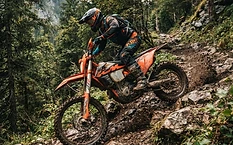
On a motocross track, the environment is relatively controlled and repetitive. Jumps, berms, and whoops are predictable, allowing riders to memorize the circuit, perfect their braking markers, and attack with maximum aggression. Enduro, by contrast, is a constant exercise in reading and reacting to unknown terrain. A single trail can feature deep mud, slick roots, jagged rock gardens, and off-camber sidehills—all within the span of a few miles. This unpredictability requires finesse rather than brute force. The track rider's instinct to square off a corner and dump the clutch will simply result in a spinning rear tire and a trench dug into the forest floor.
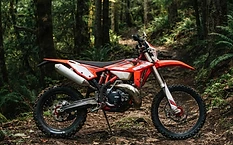
The first major hurdle in this transition is the motorcycle itself. A stiff motocross suspension, designed to absorb massive jump landings and high-speed G-outs, will deflect violently off roots and rocks in the woods, transferring that harsh feedback directly into the rider's arms. Enduro machines are engineered specifically for this compliant environment. Consider the 2025 Honda CRF450RX (previously listed here as Honda CRF 450RX). As a dedicated off-road model, it utilizes a 449.8 cc 4-Stroke engine, but its 116.1 kg (curb, full tank) chassis is paired with suspension valved specifically for trail compliance and off-road absorption. Riders making the switch must learn to soften their suspension clickers, ensure their sag is set correctly for off-road weight transfer, and perhaps most importantly, run lower tire pressures to maximize the contact patch over uneven surfaces.
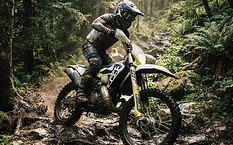
The physical approach to riding must also evolve significantly. Motocross encourages an aggressive, high-RPM riding style characterized by heavy braking and explosive acceleration. In the woods, this stop-and-go style rapidly saps physical energy and destroys traction. Enduro riders must focus on flow, carrying momentum through tight trees using smooth, deliberate throttle inputs. Standing up becomes even more critical in enduro; the footpegs are the primary control point for steering through technical sections, allowing the bike to dance beneath the rider while the upper body remains stable. Furthermore, clutch control shifts from being a tool for explosive starts to a precision instrument for maintaining traction over slippery obstacles. Slipping the clutch at low RPMs is a mandatory skill for navigating rock gardens without stalling.
Visual processing speed is arguably the biggest differentiator between the two disciplines. In the woods, the trail is constantly changing, and dappled sunlight through the canopy can hide critical obstacles. Riders must train their eyes to look much further ahead than they would on a track, scanning for the best line rather than just blindly following the main rut. Anticipation is key; seeing a root matrix early allows the rider to unweight the front end and glide over it, rather than slamming into it at the last second. This forward vision also helps in maintaining a steady breathing rhythm, which is crucial for enduring multi-hour off-road events.
Successfully adapting to enduro requires checking the motocross ego at the trailhead. It is a discipline where smoothness, efficiency, and calculated line selection ultimately yield faster lap times than raw aggression. By adjusting their machine setup and focusing on momentum and traction, crossover riders can unlock a highly rewarding dimension of off-road racing, transforming from track sprinters into complete off-road athletes.
Keep Reading


Join the Enduro University community
Create a free account to comment on this article, make race predictions, play daily trivia, build your virtual garage, enter the photo contest and climb the leaderboards.
Related Stories



Comments (0)
Be the first to comment.